A DEBUT EPIC FANTASY
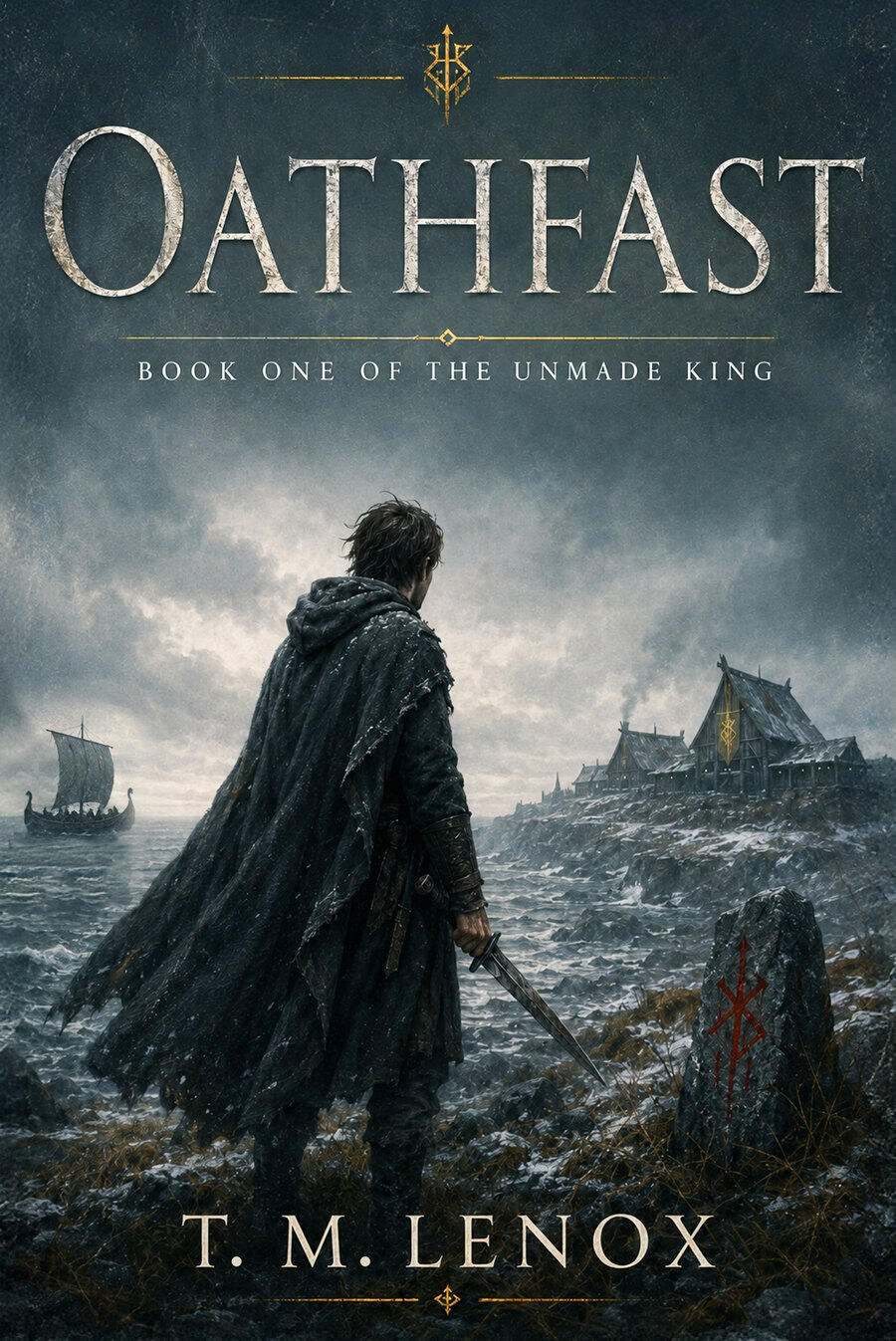
OATHFAST
BOOK ONE - THE UNMADE KING
He couldn't out-fight them. He could out-see them.
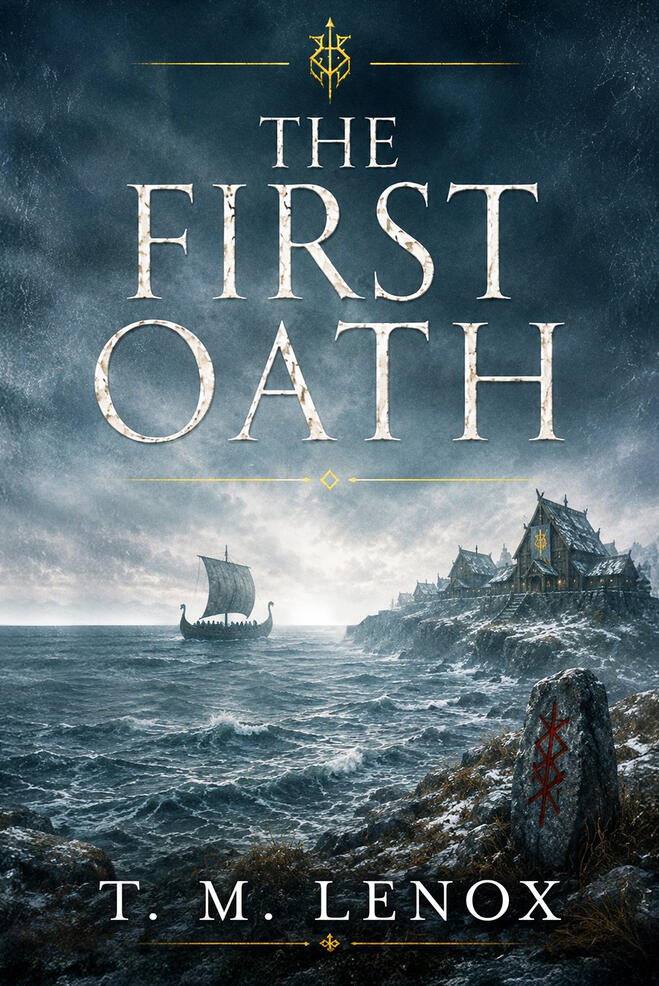
Join the list — get The First Oath, a free prequel novella, and be first to know when Oathfast releases.
THE STORY
At twelve, Edvar is put on a ship and sent across the cold sea,
given to his mother's people, the warriors of the north. The king's
second son, he is small, quiet, no swordsman like his brother. What
he can do is watch. He reads a room the way other men read weather.Six years on, word comes north: his brother, the heir, is dead.
Edvar is heir now, on the wrong side of a sea that freezes half the
year, claimed by the north that raised him, unsummoned by the father
who sent him away.Then the longships come. It looks like a raid. Edvar sees what the
war-captains cannot: the enemy's iron is too even, too well paid.
Someone far from this shore wants the north to burn.A kingdom waits across the water. A summons is already on the
road, and quiet men are ahead of it.
THE SERIES
Two books. One rapid release. The Unmade King continues.
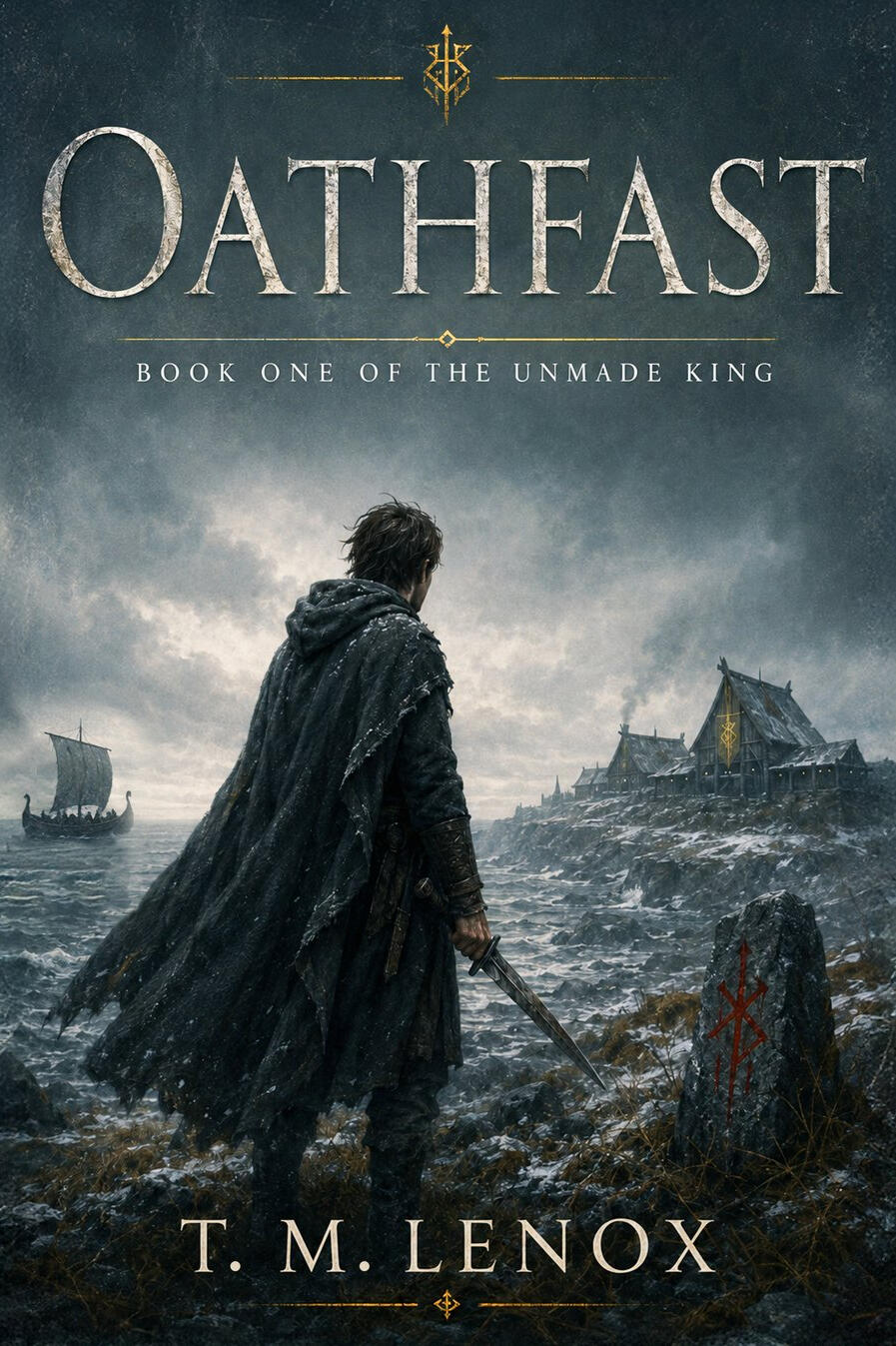
BOOK ONE
Oathfast
October, 2026
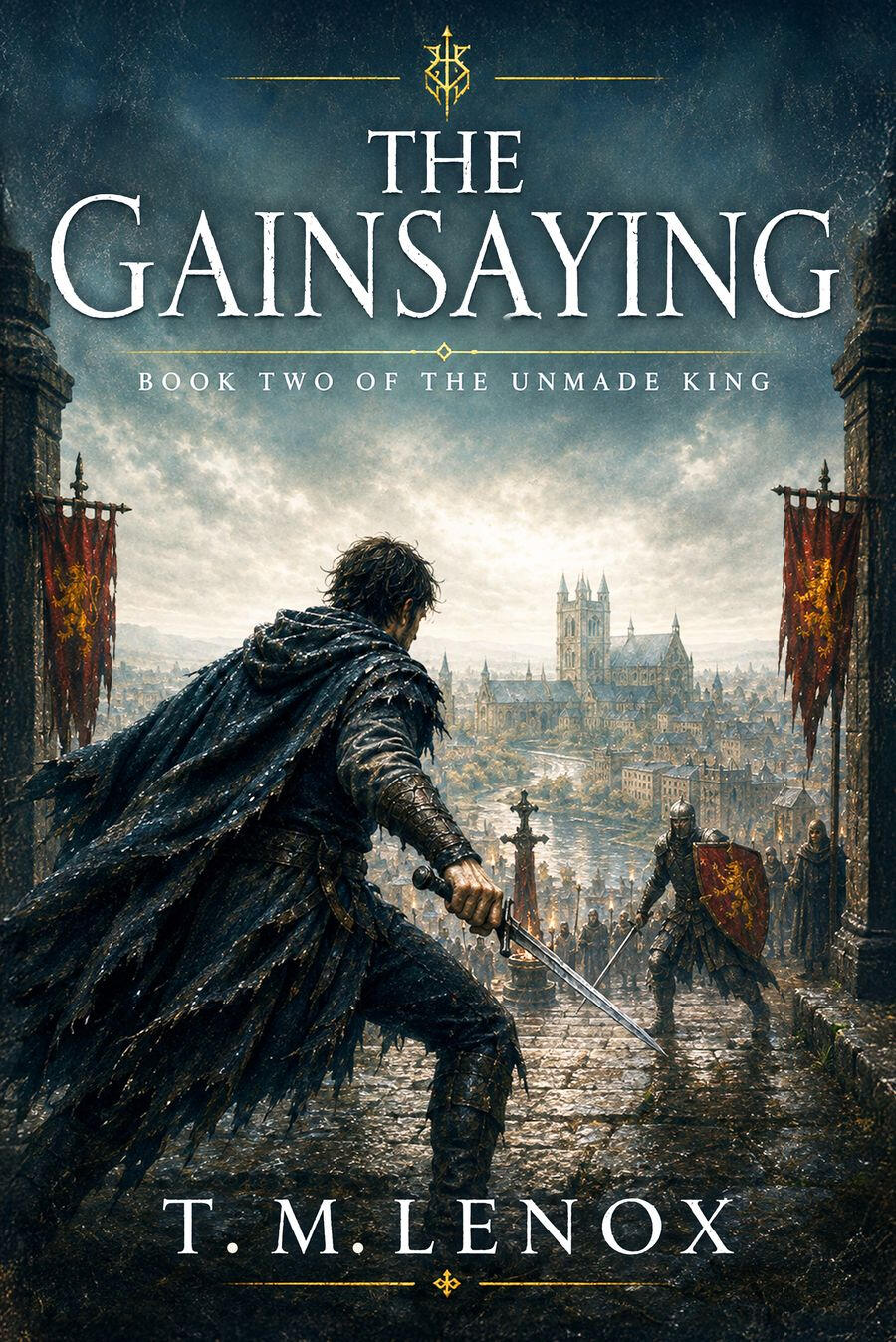
Book Two
The Gainsaying
November, 2026
THE AUTHOR
T. M. Lenox
T.M. Lenox writes epic fantasy rooted in the cold coasts and longships of the north. Oathfast is the first book of The Unmade King.
MORE FREE FANTASY
While you're here: I've joined a few group giveaways with other fantasy authors. Dozens of free books, no cost, no catch — worth a look if your to-read pile has room.
FREE FANTASY & SCIENCE FICTION FOR SEPTEMBER
AMAZING WORLDBUILDING IN FANTASY & SCIENCE FICTION
Free books are delivered by BookFunnel. Each author has their own newsletter — join as few or as many as you like.
Follow the saga north.
Sign up and get The First Oath, a free prequel novella — plus release news for both books.
THE UNMADE KING © 2026 T.M. Lenox · tmlenox.com
Chapter One
The gap from the brewhouse roof to the top of the old wall was a long stride for a grown man and a jump for Edvar, and he was across it before he had finished deciding to go.
That was the use of the roofs. Up here there was nothing to read. There was the slate gone cold and grainy under his hands, the give of moss in the joins where the rain stood, one hold and then the next, and not one of them asked him what it meant. He went along the spine of the wall at a crouch, quick, knowing the sound stone from the rotten because Tam had walked him over it in the autumn, and he kept his eyes off the yard a long way below, because looking at the drop was how a boy went down into it.
Tam was behind him and losing, which almost never happened. Tam was twelve, a year up on him and a head taller, all knees and elbows and quicker than Edvar at everything that happened off the ground. But Edvar had gone first at the gap, without the breath Tam always took before a jump, and the breath was the whole of the race.
"You'll break your neck," Tam said, from the wrong side of the gap, and he said it the way you say a fine thing about a friend.
"You first," Edvar said, and went back across.
He came down wrong. His trailing foot caught the lip of the slate and the roof came up faster than he had set himself for, and he met it with both hands and a knee and slid, and stopped. The slate had opened the heel of his palm. He watched the blood come up in the scrape, bright and thin, felt the sting arrive a beat behind it, and he was grinning, which he could not have explained to anyone in the hall and did not try to explain to himself.
Tam landed beside him soft as a cat, because Tam had taken the breath. "Your mother's going to ask about that hand."
"She won't." Edvar wiped it on his leg. It went on stinging, and he liked it, the plain animal fact of it, a hurt with nothing under it to work out.
They sat on the edge of the brewhouse roof with their legs hanging and got their wind back, and below them the hall began to wake. After a while Tam went down to the kennels, where his father would be wanting him, and the morning came back to its ordinary size.
The pony's name was Brack. Edvar had given him that name at four years old, after the dark patch on the pony's shoulder, the brack, the stable hands' old word for a flaw. The king's stable master had informed him once that the animal had a proper name already: the kind horses were given, a name that meant something. Edvar had looked at him and said nothing. The stable master had, for reasons he kept to himself, let it go.
Five years later, the pony was still called Brack.
Edvar was eleven. In his father's hall there were two kinds of people: the kind who knew his name, and the kind who knew him. They were not the same. The men at the king's table knew his name. Cedd the kennel master knew him, knew that he came to the kennels when something in the hall above was wrong, that he needed half a morning and a dog at his feet before he would say what it was, that he was good at keeping a secret when keeping it was worth something. Wren who cleaned the saddles knew him. A kitchen girl called Dessa knew him, and had taught him, in exchange for apples taken from the store without Dessa's mistress noticing, how to move through the lower passage at night without the flagstones giving him away.
He had found the kennels before he had found anything else in the hall worth keeping. Cedd ran his dogs by a system that was written down nowhere, that lived in the man himself: the order he fed them in, the order he loosed them, the low flat sound in his throat that meant a dog should leave off whatever it had started. Edvar had first been sent down there at six, by one of his mother's women who wanted him out from underfoot, and he had stayed because the kennels were the one place in the hall that asked nothing of him. On the second morning Cedd had put a bucket in his hands and said nothing about it. That had been the whole of the agreement, and it had held for five years: a boy who was quiet and did the work, a man who never once asked why a king's son spent his mornings carrying water to dogs.
The winter Edvar was eight, something in the hall had gone wrong. He had kept the shape of it and lost the rest: the lowered voices, the doors that stayed shut, the feeling of a room closed over a thing no one would name. And he had gone down to the kennels and sat against the wall with the old bitch Sarn's head on his leg until the morning was half gone. Cedd had worked around him and let him sit. When at last Edvar said the thing he had come down to say, Cedd heard it, and nodded once, and did not carry it up to the hall or anywhere else. That was part of the agreement too, the part neither of them had ever put into words. Cedd knew which things were worth keeping. He knew it the way he knew a dog was going lame a day before it favored the foot.
Dessa was sharper about it, and newer. She had come up in the kitchen by being useful faster than the girls around her, and she had taken Edvar's measure in about a week, decided he was worth an arrangement, and made one. The apples were the price of the lower passage. She had walked him through it herself, at night, three times, until he could cross the whole length of it without a single flagstone speaking under his foot, and then she had simply stopped coming and left him to it, which was how he understood the teaching was finished and judged good. She did not waste motion and she did not waste words. He had learned more from watching her run her corner of the kitchen than from most of what went on in the hall above.
These were the people who mattered. He had not decided this. It was simply true.
He was in the stable yard on the morning this begins, which is to say a morning that looked, from the outside, the same as any other. Brack stood in the corner of his stall with the untroubled stillness of a horse who has no strong feelings about the weather. Edvar sat on the lowest rail of the gate and watched him and thought about nothing in particular. This happened less often than people assumed. He valued it when it came.
This was the hour he kept for himself, the gap after the apprentices had finished the early feeding and before the knights came down for the morning ride. It belonged to nobody, which was the only kind of time he fully trusted. He sat and watched the light come up gray over the old stone and listened to the hall waking above him, not the words, only the shape of the sound, a door, a bucket set down, a voice carrying across the upper yard and another answering it. He could have told you, most mornings, who was already up and who was not, and roughly what kind of day the hall was going to have, from the sound alone. He had never tried to learn this. It had come the way most things came to him, by his being there long enough and paying attention when no one thought he was.
The stable yard was enclosed on three sides by the old stone buildings, the ones from before his father's father's time. The fourth side opened onto the lower court, and the lower court onto the main yard, and the main yard to the hall. He knew how sound moved through these spaces, what carried, what didn't, the hour the stable master made his rounds and the hour he didn't. He had learned it by sitting in the yard, season after season, until the pattern was his.
His brother's voice he could pick out even through stone, not because it was loud but because of how other voices arranged themselves around it. The careful voices, the high table voices, the voices of men who had been talking to a king's heir long enough that they had started to sound like one. Edhelm was twenty. The hall was learning his weight.
Tam came through the gate at a run, which meant something had happened or he was bored.
"They want you in the hall."
"Who does."
"Your mother sent someone. The girl from her rooms."
Edvar looked at Brack once more. He put a hand on the pony's nose briefly, the way you say goodbye to something when you don't know you're doing it. Then he followed Tam across the yard.
The lower passage ran from the stable court to the hall's east wing without passing through the main yard. Cold, smelling of damp stone and unlit tallow. Edvar had mapped it his third winter, when his brother had known all the ways through the old buildings and had not wanted to share them. He'd found them himself. It had taken most of that winter, going section by section, keeping a count.
He came up through the east wing and Runa was waiting at the turn of the corridor. She was perhaps a year older than him, dark-haired and quiet in the particular way of someone who has learned that being quiet is useful. She had been in his mother's rooms for as long as he could remember, brought from the north before he was old enough to notice her arriving, which meant she had simply always been there, like the fire in the south-facing room and the smell of the herbs hanging from the ceiling beams. He had never thought much about her. She was part of his mother's world, not his.
She turned without saying anything and led him down the corridor.
His mother's rooms faced south. In winter she kept a fire through the day, and the room smelled of woodsmoke and the herbs her women hung from the ceiling beams, and something else underneath that he had never been able to name precisely. He had decided, at some point, that it smelled like his mother's stories. This was not a clear thought, but it was accurate.
She was sitting with two of her women when he came in. Marra was sewing. The other woman was reading aloud from something in the northern tongue, which his mother called the old tongue and the rest of the hall called the Norse. His mother was watching the fire.
She turned when she heard him, and he crossed the room and sat on the low bench near the hearth. The reading stopped. Solvara said something to her women, and they went out, and it was just the three of them: his mother, Edvar, and Runa somewhere behind him near the door.
He let the fire's warmth reach him before she began. The hall taught a boy to hold still and give nothing away; his mother's rooms were the one place where holding still meant he could set a little of it down, because the women here did not trade in what they saw. He waited. She always began when she was ready and not before.
"There is a feast tonight," his mother said.
"I know."
"You will be at the table." She paused. "Your father will have something to say to you. About the riding demonstration last week."
He looked at her. She had told him this two days ago. She was telling him again for a reason.
The riding demonstration. He was not a bad rider. He was simply not Edhelm, who moved on a horse the way certain men moved in a fight, without thinking, as though the body knew more than the mind could reach. Edvar had done what he could. It had not been what his father was looking for.
"What will he say?" Edvar asked.
"That you should train more. That you have not applied yourself."
"I train every day."
"I know."
He understood that she was not telling him this so he could argue. She was giving him time to build something to put between himself and the words before they arrived. He was grateful. He was also aware that being grateful for this was not right, that it should not have to be given.
"Is he angry?" Edvar asked.
From near the door, behind him, Runa said, "He was."
His mother said nothing. He sat with her a while longer. The fire moved. Her women came back in, and one of them brought food, and he ate it. His mother spoke to Marra in the old tongue about something he could not follow. He had more of the language than he let people know. The words her women used every day had settled into him the way the stable sounds settled, the way anything settled if you sat near it long enough. He understood more than he could speak. He had not told his mother this. He was not sure why.
He knew when it was time. He rose and kissed his mother's cheek, and she held his face in her hands for a moment. Her hands were cool and unhurried, the hands of a woman who had long ago trained the fret out of them.
"Be still tonight," she said. "You know how to be still."
He did. It was, as it happened, the thing he did best.
The hall filled at dusk.
Edvar knew the seating by habit. He had memorized it the first year they'd used this arrangement, which was the year of the western negotiations, when everything had shifted by half a seat to accommodate the delegation. He knew who sat where, who had moved, and what it meant when someone moved. It was not a skill he had cultivated. He had simply, at some point, found that he had it.
The room was filling and he read it while it filled, the way he breathed, without choosing to. The eastern thane had come with fewer men at his back than he had brought in the autumn, three where there had been five, which meant either that the holding was short of men or that the thane wished it understood he was not anxious about the southern road, and Edvar could not yet say which, so he kept it. The elder of the two Vaelric priests had settled a half-seat nearer the salt than was his by custom. It was the sort of small movement that was either nothing at all or the only thing in the hall worth seeing, and there was no telling which until later, sometimes much later. The steward worked the low end of the table with the smooth, even attention of a man counting heads without letting anyone feel counted.
None of it came to anything yet. That was usual; most of what he saw never came to anything. The use was in looking regardless, because the pieces were easier to keep as they arrived than to hunt for afterward, once you knew which ones you had needed.
He sat at his place near the end of the high table, in the seat that acknowledged his birth without claiming too much for it. Edhelm was at the king's right. The king was at the center.
His father was not a large man. This was the first thing that struck visitors, Edvar had gathered, because the things you heard about King Aeldric suggested someone large: the battles, the borders held, the enemies named and dealt with. He was not. He was compact and still, and the stillness was the kind that had been built from use rather than temperament, the way a weapon-handle is worn smooth from the hand that has held it for thirty years. When Aeldric moved in the hall, the hall noticed. When he was still, the hall watched the stillness.
He was looking at Edhelm now, listening to something Edhelm was saying, and his expression was the expression of a man looking at something he has made and finding it well made. Edvar watched this without appearing to watch it, a habit he had developed of seeing from a slightly wrong angle so that it was not obvious he was seeing at all.
Edhelm was talking about the salt road. A section that had failed in the winter rains; he had ridden it himself to see the damage and had opinions about the repair. The king was asking questions. The questions were good, pointed and practical, and Edhelm answered them well. He had been the kind of boy who read about roads, about law, about grain storage, about all the workings of a kingdom, because he knew they were his to inherit and he was the kind of person who prepared.
The men near the king's end listened to him the way you listen to weather you have already decided to trust. One of the household captains put a question to him about the autumn carts, and Edhelm answered it almost before it was finished, not rudely, only because he had already been down that road in his head and knew where it came out. Edvar watched the listening more than he watched his brother. It was usually the listening that told you the thing; the man speaking only gave you the words.
What Edhelm was laying out was the salt road, the long one that ran down to the coast, and somewhere in the detail of it Edvar caught a thing and set it aside to look at later, not in the road itself but in the room: which of the men leaned in when the cost was named, and which sat back, and that the two sets were not the ones you would have guessed from who used the road. He did not know yet what it meant. He was eleven and it was not his question. But he kept it, because the keeping cost nothing, and because his mother had taught him, before he could have said what she was teaching, that the cheapest thing in any hall was a fact nobody thought you were old enough to hold.
Edvar looked at them and thought: my father will die someday, and my brother will be king, and this is the right order of things. He meant it without bitterness. It was only the order of things.
He ate his food. Farther down the table, past the thane from the eastern holding who always ate too quickly, past the two Vaelric priests who had been at court as long as Edvar could remember, there was a man he had not seen before. Or had seen once, briefly, in the outer yard three weeks ago, wearing different clothes.
He looked at this man the way he looked at things that were not quite adding up.
The man was perhaps forty. Well-dressed in the way of someone who has learned to dress well for occasions and has not made it fully natural. He sat between two of the king's household men and was speaking to neither of them, which was not how you behaved if you were there by arrangement. He was watching Edhelm.
Twice while Edvar watched him, the man's eyes went to the king and came back to Edhelm, and the second time they stayed on Edhelm, which told Edvar that whatever the man had come to learn was about the son, and the father only as the thing the son would one day stand in. His hands stayed still on the table. He drank little. He had the look of a man being paid for the evening rather than spending it.
Edvar ate and watched the man watch his brother and could not land on anything conclusive, so he filed it with the other things that were not yet conclusive, and went back to his food.
The wine came. Conversations opened up. A man two seats away told something that made the people near him laugh. Edhelm, at the king's right, said something that made the king smile.
Edvar had been waiting, without quite admitting it to himself, to hear his father say the thing his mother had warned him of, the words about the riding, about applying himself. He had built what he could to set between himself and them. But the feast went on and the words did not come, and after a while he understood they were not coming tonight, and he was left holding a guard against a blow that had not landed, which was its own small uselessness. He set it down. He had learned that too: not to keep carrying a brace after the moment you had braced for had gone by.
Then his father turned and looked at him.
It was not a long look. The look of a man checking something he already knows, confirming a fact that requires no revision. His father's gaze moved over him the way it moved over furniture, not unkind exactly, not dismissive, simply settled, the look of someone who has reached a conclusion and sees no reason to reopen it. Then Aeldric turned back to Edhelm.
Edvar ate his food.
He was very still.
He left when it was polite to leave, which was when the wine had been going around long enough that no one was watching who came and went. He went through the east wing and the lower passage and out into the stable yard.
The night was cold and clear. Brack stood in his stall with his eyes half-shut. Edvar sat on the rail and let the cold settle him, which was what he came here for.
The hall behind him was loud in the way it got loud late, the wine doing its work, the voices climbing over one another. Out here there was the cold and the small shifting sounds of the horses and nothing that asked to be read. He had spent the whole feast reading. It was a relief to sit somewhere that wanted nothing from him, the way the kennels had wanted nothing from him at six. He thought, not for the first time, that the two kinds of people in his father's hall kept two kinds of rooms, and that he had always been easier in the second kind.
His father had not said anything about the riding. His mother had prepared him for a thing that had not come, which meant it was coming later, or it had passed the way some things passed, the moment going by quietly, becoming the kind of thing that was not said and then was never said.
He did not think it was the second.
He looked at Brack's face and thought about the man who had been watching Edhelm. He would not see that man again for a long time. He did not know this yet. He kept the memory carefully, with the others.
The night was quiet. The hall sounds had died. Somewhere in the upper rooms a fire was burning, sending a thread of smoke across the stars. He would be twelve in the spring. Edhelm was twenty. Their father was fifty-one or fifty-three; he had heard both numbers and was not certain which was right.
These were the facts. He arranged them and looked at them. Then he stopped, because there was nothing in the looking that helped, and it was late, and Brack had opened one eye and was watching him with the equable patience of a horse that knows people come to the stable when they need to be near something quiet.
"All right," Edvar said. He put his hand on the pony's nose, and Brack accepted this. That was enough. He went inside.
That is the opening. OATHFAST runs about 157,000 words, four points of view, and it goes on sale October 6.
Want an advance copy?
Reply to the email that brought you here with a yes.
That is the entire process. The finished ebook reaches you on September 8, free, four weeks before it goes on sale.
Lost the email? Send a yes here instead.